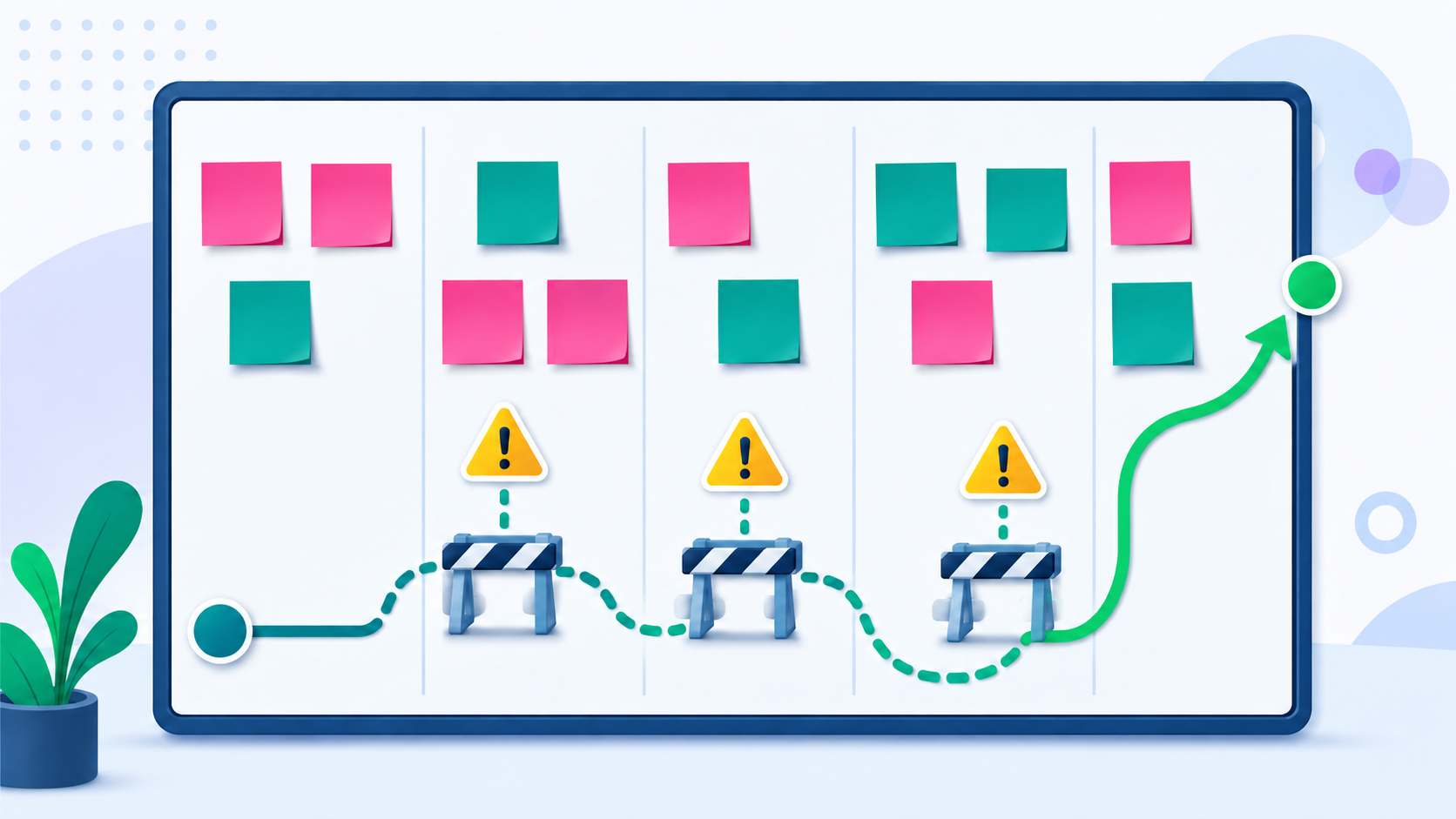
Constructive discussion points that help Scrum teams understand obstacles, improve their
processes, and choose achievable changes for the next sprint.
Why Discuss What Didn't Go Well?
A Sprint Retrospective gives the team a regular
opportunity to examine friction while there is still time to improve. The goal is not to produce
a list of complaints. It is to understand what made work harder and agree on a useful response.
Keep the conversation focused on systems, processes, and conditions rather than individuals.
“The handoff left too little time for testing” creates room to improve workflow. “Testing was too
slow” assigns blame without explaining the conditions that caused the delay. Specific, neutral
observations make honest discussion safer and more productive.
What Didn't Go Well Examples by Category
Sprint Planning
Several stories entered the sprint before their acceptance criteria were understood.
The team committed to more work than its known capacity could support.
An external dependency was discovered only after development had started.
The sprint goal was too broad to guide tradeoffs when priorities changed.
Communication
A design decision changed, but not everyone affected by it received the update.
Blockers were discussed privately and did not become visible to the full team.
Important questions remained unanswered because ownership was unclear.
Meetings ended without confirming decisions or next steps.
Development
A large pull request took several days to review and delayed dependent work.
Unexpected complexity caused one story to consume most of the sprint.
Frequent context switching slowed progress on the sprint goal.
Local setup differences made a defect difficult to reproduce.
Testing
Most stories reached testing during the final two days of the sprint.
Unclear test scenarios led to repeated clarification and rework.
An unstable test environment interrupted planned verification.
Manual regression testing left too little time for exploratory testing.
Deployment
A release required undocumented manual steps and took longer than expected.
Configuration differences caused staging behavior to differ from production.
A failed deployment did not provide enough information for a quick diagnosis.
The team discovered a missing rollback step during the release.
Team Collaboration
Specialized knowledge created a bottleneck around one area of the product.
Team members worked independently on related changes and found conflicts late.
Urgent support work repeatedly interrupted planned collaboration.
Quieter perspectives were not heard before the team made a decision.
Process
Work entered the sprint without following the team's agreed readiness criteria.
A previous retrospective action item was not reviewed or completed.
Standups regularly exceeded the timebox without resolving blockers.
Unplanned work was added without discussing its effect on the sprint goal.
Technical Debt
A fragile module required repeated fixes for otherwise small changes.
Slow automated tests delayed feedback on every pull request.
Missing documentation increased the time needed to change an older integration.
A postponed dependency upgrade blocked use of a needed framework feature.
Keep the Conversation Constructive
Start with observable events and their impact. Then explore contributing conditions before
deciding what to change. This approach keeps the team curious and reduces the temptation to jump
straight from frustration to blame.
Focus on problems, not people. Describe the workflow, constraint, or missing information.
Identify root causes. Ask what conditions allowed the problem to occur or continue.
Prioritize improvements. Address the recurring issue with the greatest team impact first.
Select achievable actions. Choose a small change the team can complete or test next sprint.
Celebrate learning. A difficult sprint can still reveal information that helps the team improve.
Do not try to solve every problem raised during one meeting. Group related observations, choose
the issue with the greatest impact, and agree on one concrete experiment or action. Assign an
owner and review the result at the next retrospective.
Reviewing both What Went Well examples and challenges gives
the team a balanced view of the sprint. The broader collection of
Sprint Retrospective examples shows how observations,
action items, and recognition can work together in a complete session.
Teams that want a structured way to act on these observations can use a
Start, Stop, Continue retrospective. When the
emotional impact of a difficult sprint also needs space, a
Mad, Sad, Glad retrospective can help the team discuss
frustration and disappointment without losing sight of successes.
Experience These Examples in BugNBrag
Explore a live demonstration board containing representative What Didn't Go Well cards from this guide.